


Rostislav Stary is Partner at Konektor, a leading strategic communications agendy based in Prague (Czech Republic)and Bratislava (Slovakia)
Don't rely on emotions, treat trust as capital
Trust has always been fundamental to communication. However, at a time when, according to the Edelman Trust Barometer, trust is continuously declining, its importance is growing. The Edelman Trust Barometer has long tracked its erosion: 61% of the global population feels wronged by the system. People believe that governments and business favour the privileged and make life worse for ordinary citizens. Mistrust affects not only institutions, but also brands, CEOs, media and new technologies including AI.
Only 36% of respondents believe their children will live better than them. Frustration and loss of hope is also reflected in approval of radical forms of activism: 40% approve of the spread of misinformation, online attacks, and even violence as a means of change. Among the under-34s, the figure is as high as 53%.
In an environment where trust in all things is breaking down, it raises a fundamental question: how to make people trust your brand?

Trust needs management – not just a feeling
Though trust is crucial there's one fundamental challenge: it's a feeling. You either have it or you don't. Sometimes you even think you have it, but you don't. For years, trust has been treated as an elusive sentiment – difficult to define and even harder to measure. Often understandable for PR people only. Yet it is untenable for communications and business leaders to manage an important area based on intuition. We need a measurable and manageable concept.
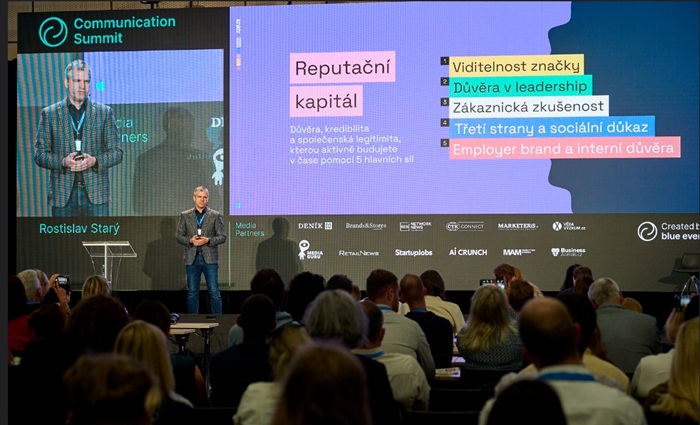
The way to go, I think, is to think of trust and reputation as capital. Reputational capital is the trust, credibility and social legitimacy that you actively build over time. It is measurable, has a clear impact on the company, and is also understood by the CEO, CFO and other key managers outside the communications department.
From Bourdieu to Grayson: capital as the key to trust
I draw on the work of French sociologist Pierre Bourdieu, who showed in the 1980s that a person's success depends not only on economic capital, but also on cultural and social capital – that is, education, cultural insight, language codes and social networks. These forms of capital affect our credibility and legitimacy.
It works similarly for companies. Economic performance is fundamental, but reputational and human capital have a major impact on it. A good reputation allows a company to more easily attract talent, increase employee loyalty, attract investors and withstand crises. It is a source of growth for the firm and a strategic asset that supports its performance and risk resilience.
The importance of reputation is further reinforced by more recent studies on trust. For example, Kent Grayson of Northwestern University defines trust as "the process of calibrating expectations", allowing trust being established when expectations are consistently met. Rachel Botsman then talks about the shift from traditional "institutional trust" to "distributed trust," where people increasingly trust individuals, communities, and technologies rather than institutions.
The five forces of reputational capital
To develop the idea of reputation capital further, I use findings of many global trust studies, my own research with NMS Market Research, interviews with experts and more than 20 years of experience in PR, and define five key forces that shape reputational capital:
1. Brand visibility
People may not realize it, but they have a natural tendency to trust well-known brands more. This is the 'mental accessibility effect' (Byron Sharp). However, visibility alone is not enough – it must be linked to positive sentiment, the right associations and differentiated positioning.
Visibility can be measured by media monitoring, ideally in the context of competitors. Primarily, I'm talking about earned media analysis, because trust cannot be bought - you have to earn it. At the same time, all studies confirm that the impact of PR activities on trust is significantly higher than that of advertising.
2. Leadership and its credibility
Brands are built by people – and consumers perceive the leaders of a company as key representatives of its credibility. This is why the importance of personal branding of CEOs and top management is growing, and why we see the success of brands where strong leadership is at the forefront of the brand. Data shows that 82% of people trust companies whose leaders actively communicate on social media. Leadership reputation can be quantified by analyzing media and social networks.
3. Customer experience (direct and mediated)
The first two forces, brand visibility and trust in leadership, are most influential in terms of trust research at a stage when people have not yet had a personal experience with the brand. At this stage, WOM is key to building trust. In the next phase, it is then the customer experience. But alongside personal experience, mediated experience – reviews, ratings, user comments – also has a huge impact.
In a series of experiments we tested the influence of various attributes (price, number of stars, number of reviews). The result? At a competitive price, positive reviews have the greatest influence on purchase decisions. This area is well measurable using NPS and data from platforms such as Heureka, Google Reviews, etc.
4. Third parties and social proof
The fourth force is your advocates. Partners, associations, experts, ambassadors... Respected third parties who will support your narrative and your arguments. Plus social proof in the form of certificates, quality labels and so on. We all understand the power of third parties in PR, they are often crucial in crisis situations, but their importance grows even in calm periods. For this parameter, the assessment is more subjective, but again, in the context of competition, undoubtedly possible.
5. Employer branding and internal trust
If your employees don’t trust you, neither will the public. The importance of employer branding has increased dramatically in recent years, even in the wake of the pandemic. 86% of job seekers say that employer reputation is a major factor for them – even more so than career advancement opportunities. HR measures employee satisfaction with surveys, and we can also use data from portals like Atmoskop, Glassdoor, Indeed, etc.
The Reputational Capital Index: a concrete map of trust
The five forces of reputational capital described above can easily be translated into a practical management tool: the Reputational Capital Index. Each of the areas – brand visibility, leadership, customer experience, third parties and employer branding – can be rated on a scale of 1-100 and the results displayed on a radar chart. This provides a clear map that intuitively shows where the brand is strong and where there is room for improvement, or where it can further increase its lead over competitors or industry benchmarks. The result is a specific index that can be monitored, evaluated and, above all, managed on the basis of its reputation capital.
The index also has the advantage of flexibility. Different metrics can be used for different areas depending on the data available to the company – and often it is just a matter of gathering this data from the different departments that already have it: HR, PR, marketing, CSR or customer care. Where data is not yet available, it is not fundamentally difficult or expensiveto collect.
High time to start measuring reputational capital
Reputational capital translates the abstract concept of trust into a concrete strategic framework that can be systematically measured, managed and evaluated. It also offers communications leaders a powerful argument for board-level debate: just as no CEO runs a company without a financial plan,neither should he or she run it without a reputational plan.
Evolving landscape makes reputation capital not simply desirable – but essential for corporate survival. And time is running out to build one. We are entering an era where brand trust is threatened not only by traditional crises but also by new phenomena: sophisticated disinformation campaigns, generative deepfakes, hyper-realistic propaganda and real-time manipulation of public opinion. In such an environment, it will no longer be possible to rely on gut feeling – reputations will have to be systematically built up over the long term. Companies that start building reputational capital early on will simultaneously create a robust defensive and competitive advantage for the turbulence of the years ahead. This is the only way to maintain trust in a world where trust is scarce.